Why the decline in global poverty requires a living income and living wage agenda
By Ian Prates
Extreme poverty fell from 36% of the global population in 1990 to 9% in 2015. But understanding how this decline happened is as important as measuring its magnitude.
An outstanding working paper by Vincent Armentano , Paul Niehaus and Tom Vogl at the NBER, based on data from China, India, Indonesia, Mexico and South Africa - countries that accounted for 75% of the global reduction in poverty between 1990 and 2015 – shows that poverty exits were real, but often unstable.
Among households that were initially poor, poverty exits ranged from 45% in rural India to 67% in China. At the same time, among households that were not poor at the beginning of the period analyzed, poverty entry ranged from 13% in Indonesia to 34% in Mexico.
This finding is central to the living wage and living income agenda.
It shows that crossing a poverty line does not necessarily mean achieving economic security. Many families manage to move out of poverty but remain close to it – exposed to price shocks, job loss, illness, income seasonality, debt, production losses or market instability.
That is why LivingWage and LivingIncome should not be treated only as instruments for “poverty reduction.” They play a more structural role: they help move workers and producers into a less vulnerable position within the income distribution and make them less exposed to the risk of falling back into poverty.
The poverty line measures deprivation and identifies who is below a minimum survival threshold. By contrast, the LivingWage and LivingIncome agenda asks what level of remuneration is necessary for a family to have a decent standard of living, considering healthy food, adequate housing, health care, education, transportation, clothing, communication, some provision for unexpected events and a minimum margin of security.
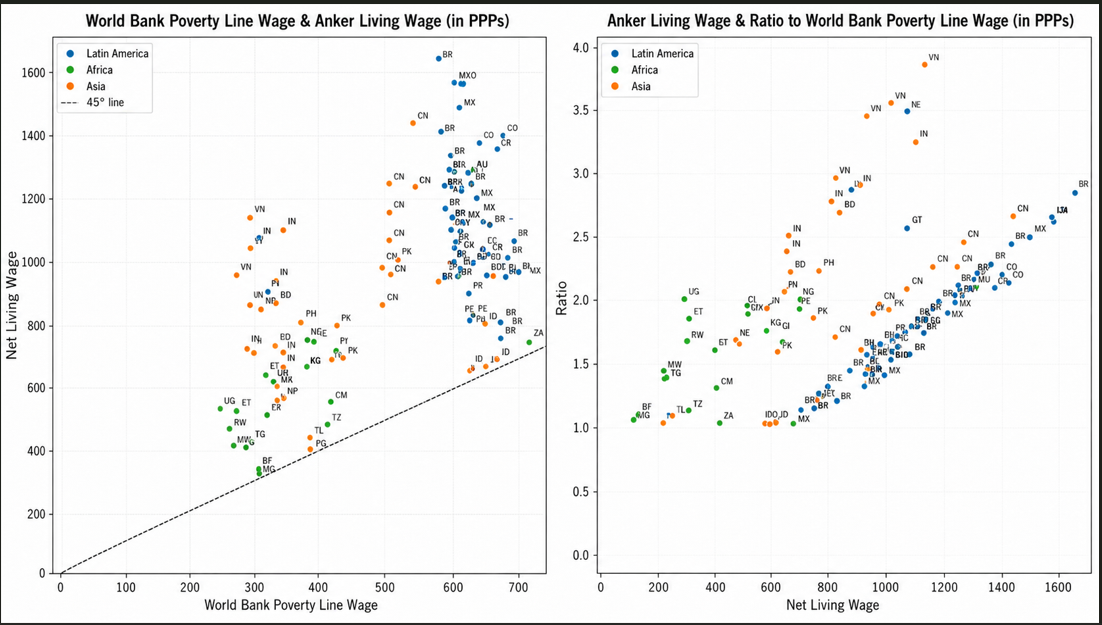
The graphs reinforce this point by comparing the The World Bank Group poverty-line wage and the net living wage values calculated by the Anker Research Institute , in purchasing power parity terms, for 40 countries with studies across different locations.
The comparison shows that virtually all countries are above the 45-degree line, indicating that the net living wage is higher than the value associated with the World Bank poverty-line wage. This pattern reveals a significant distance between escaping monetary poverty and achieving remuneration compatible with a dignified life. Africa is more concentrated at lower absolute values, both for the poverty line and the living wage, although relevant gaps between the two indicators remain. Latin America shifts toward higher levels, especially in countries such as Brazil, Mexico, Colombia, Costa Rica and the Dominican Republic. Asia shows greater dispersion, with some countries combining relatively low poverty lines with much higher living wages, suggesting wider gaps between the minimum needed to avoid being considered poor and the real cost of a dignified life.
This interpretation becomes even clearer in the second graph, which presents the ratio between the net living wage and the World Bank poverty-line wage. Latin America concentrates higher living wage levels in absolute terms, but with ratios generally between 1.4 and 2.6, with important variation, as in the case of Nicaragua. Asia shows the greatest dispersion in ratios, with countries such as Vietnam and India showing particularly high relative differences between the living wage and the poverty line. Africa, in turn, is concentrated at lower absolute living wage levels, with ratios closer to 1.1 to 2.1, although there are exceptions such as Mauritius and South Africa.
Taken together, the two graphs reinforce that the poverty line, while extremely relevant for public debate and policymaking, is an insufficient benchmark for discussions on adequate remuneration. Overcoming monetary poverty does not necessarily mean achieving income capable of sustaining food, housing, health care, education, social participation and minimum protection against shocks, such as highlighted by the last #GlobalWageReport from the International Labour Organization.
This difference is not only methodological, but also political. If poverty is a “slippery slope,” as the authors suggest, public policies and business practices need to go beyond celebrating reductions in poverty rates. The central question becomes: are incomes sufficient, regular and predictable enough to prevent workers, producers and their families from returning to vulnerability when the next shock comes?
The study also shows that there was no single pathway out of poverty. Migration, sectoral change, wage employment, self-employment, women’s participation in the labor market and transfers played different roles depending on the country. In many cases, families moved out of poverty without changing sector, occupation or place of residence.
This conclusion is especially important for value chains and highlights how the LivingWage agenda requires attention to wage floors, working hours, net remuneration, benefits, deductions, stability and mechanisms for updating pay in line with the cost of living. In the case of producer families and self-employed workers, the LivingIncome agenda requires attention to fairer prices, productivity, production costs, climate risks, market access, purchasing practices and the distribution of value along the chain.
In both cases, however, the challenge is not only to lift families above the poverty threshold, but to create the conditions for them to remain out of poverty. This is where the LivingWage and LivingIncome agenda broadens the debate on #SustainableDevelopment, shifting the focus from minimum survival to economic security, predictability and the ability to sustain a dignified life over time.
If poverty can be a “slippery slope,” living wages and living incomes are part of the infrastructure needed to make the exit from poverty less fragile, less reversible and more compatible with the real promise of Sustainable Development.
The views and opinions expressed here are those of the authors and do not necessarily reflect the position of the Anker Research Institute.